
Taking bold measures is off the radar when the leadership team is operating on low TRUST.

Updated: Sep 16
Leadership teams are under pressure to make bold moves, a symptom of the evolving uncertainty and economic turbulence and their forever changing landscape. And making these kinds of moves requires a lot of robust discussions and eventually unity on the way we move forward.
But this is off the radar for leadership teams when Trust is low. Low Trust amongst a team affects how people feel and it changes what they are willing to do. And it means they are less likely to find agreement with riskier strategies and decisions.
Low trust creates risk aversion: When people don't feel safe to fail, challenge or speak up, they naturally protect themselves. Innovation and bold decision-making get harder.
And you are more likely to observe misalignment between individuals, even disagreement that creates tension publicly. People will choose self-protection over contribution: If we don't trust that leaders will listen, support us or have our backs, we are less likely to be vulnerable and put forward the unconventional idea or take the calculated risk.
The indicators your leadership team is operating with low Trust? Perhaps you recognise some of these. Distractions in meetings, the leader we defer to relies on AI to respond or do the thinking for them, we try to ignore the tension resulting in some awkward moments in leadership meetings, strained relationships amongst some members impact the team, the call from another leader to have a meeting after the meeting, the awkward decision-making process (or lack of), the deferring to the most senior person, the apathy - sitting back, the lack of clarity, the facial expressions people can't hide.
Trust is an enabler of performance: Building trust isn't about making everyone comfortable. It's about creating enough safety and confidence for people to be vulnerable and have courageous conversations, experiment and challenge the status quo.
Trust is built through intentional commitments, communication and agreement - and observable behaviour that aligns with those agreements and ways of leading. When this happens it creates a culture where people feel the temperature is right for bolder decisions, and there is more likely an appetite for risk taking.
And if you want to build Trust throughout your culture? It's not that easy when it doesn't exist at the top. The distrust seeps through to all teams. And that's when the organisation is hit with errors, low productivity, high turnover, overly cautious (or a lack of) decision-making.
So be intentional about a culture throughout that is high in Trust and Psychological Safety. It's not a once off agreement, and its holding ourselves accountable always.
Does having high Trust improve the outcome for leadership teams? Not automatically. A bold move only pays off when the thinking behind it was rigorous, or when it's a decision long overdue and simply delayed by a lack of nerve. Rigorous thinking done collectively is fuelled by both trust and high psychological safety.
A macro moment - a broken promise, a restructure handled badly, a leader who publicly undermines another - may immediately shift Trust. But it's the micro moments that slowly chip away at it, the small disengagements and unspoken tensions that no one names.
What could you do to rebuild it, more importantly where do you start ?
Establish a baseline, where is the team at, where does alignment exist, what is misaligned and how intense is it. Be clear on what the team needs to work on. Generally we find it's relationships, communication, a lack of vulnerability and psychological safety.
Start with communication. Get better at communicating with each other, check for clarity, keep people informed that need to be informed and if you're not sure, ask them and invite them in. Open communication creates transparency and lets leaders know it's ok to be vulnerable.
Listen as much as you communicate to others. And listen empathically so people feel heard and relationships can start to slowly mend.
Work on the fractured relationships and gain agreement on how to move forward.
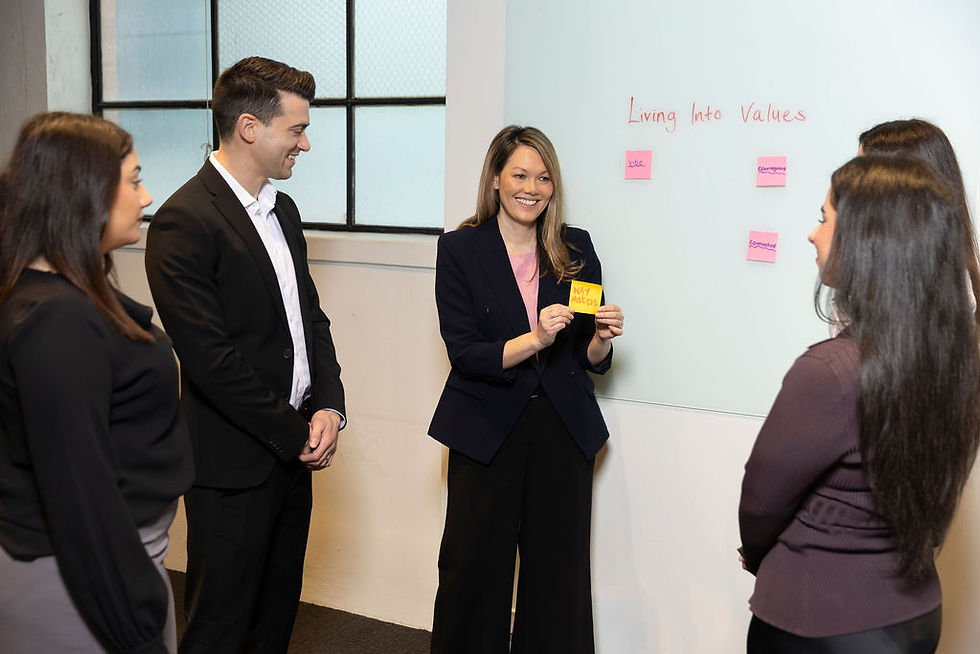
Agree on the values that are priorities for everyone, dig deep into how these should be lived by the leadership team. Build them collectively, and don't expect this will happen overnight - bring in an external party to help you bring it together into a charter.
Give the team time to take these steps (as slowly as Trust was broken it needs to be rebuilt) and when the team is ready, lean into a discussion that creates agreement on what is needed to discuss when things don't go well - to create a learning culture and reward vulnerability. Add this to your Values agreement.
These steps can help you start the journey, you'll find when you start to talk about rebuilding Trust, communication - transparency, openness, listening, vulnerability and empathy will surface over and over again.
And if you feel you need to bring someone in to support your leadership team - call us in.
melina@peopleq.com.au I 0498 800 008


Comments